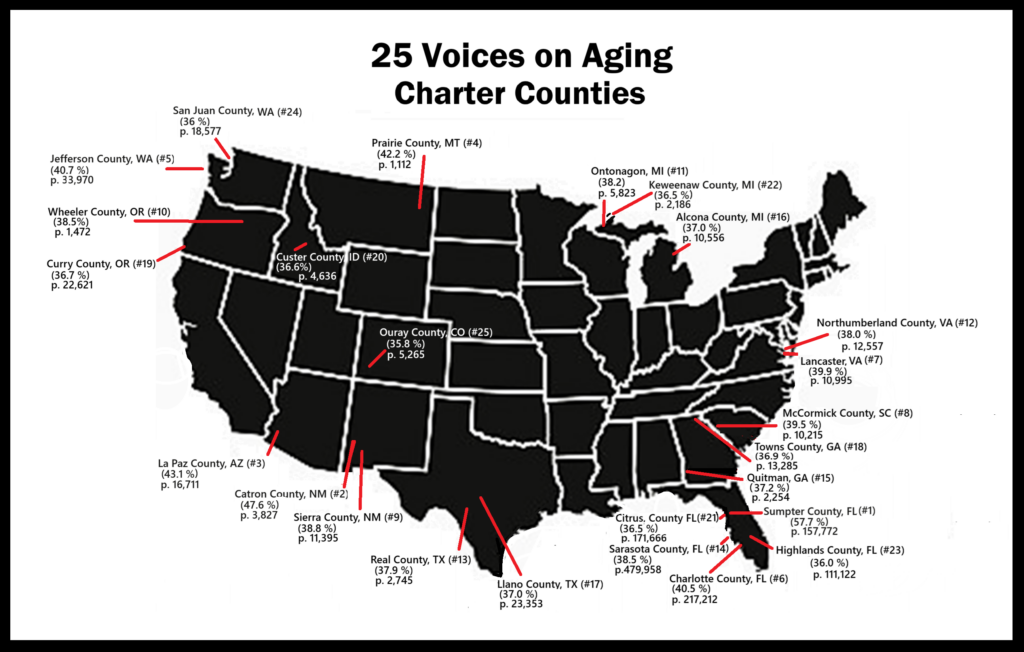
This initiative examines the 25 counties in the United States with the highest percentage of older residents. These are called THE CHARTER 25 COUNTIES.
These communities are a bellwether for the rest of our nation, offering an early view of the demographic conditions that will increasingly shape communities across the country.
The Five Charter 25 Community Clusters
The Charter 25 counties share one important characteristic: each has an unusually high percentage of residents age 65 and older. But they did not arrive there in the same way—and they do not face the same planning challenges.
To better understand those differences, the 25 counties are organized into five clusters. Each county is placed according to the planning condition that speaks the loudest, while recognizing that many counties share characteristics with more than one group.
1. Functionally Stable Growth Counties
These counties show a pattern of *two-tiered growth. Their older population is increasing significantly, but the county as a whole is also continuing to grow and attract new residents. At the same time, older households have comparatively strong annual incomes, giving many older residents greater financial stability as the community changes.
This combination sets these counties apart from communities where the older population is growing while the overall population, workforce, or economic base is shrinking. Here, population growth is occurring across the community while the expanding older population also brings meaningful purchasing power and economic activity.
Counties:
Sumter County, Florida
Sarasota County, Florida
Charlotte County, Florida;
Ouray County, Colorado
Towns County, Georgia
The Pattern:
These areas attract retirees with financial resources, stable housing, and access to services that can be privately secured. Digital connectivity and local infrastructure support a high level of independence and engagement.
At the same time, the cost of living rises with demand. Housing and daily expenses make it difficult for service workers and caregivers to remain in the area. Over time, this creates gaps in the local workforce needed to support an aging population. The community maintains a high level of function, but it relies on a workforce that increasingly lives outside the county or is in short supply.
What to Watch:
Communities begin to resemble this pattern when housing costs rise faster than local wages, when service workers commute from outside the county, and when older residents can meet most needs privately while essential support roles become harder to fill.
What Often Works Here:
Financial stability, education, and connectivity support strong civic engagement, philanthropy, and the ability to pilot new programs. These counties often have the capacity to lead, test solutions, and invest in quality of life at a level others cannot.
Defined:
*1. 65+ population growth of at least 13% from 2020–2025
2. Net domestic migration of at least 15 per 1,000 residents per year
Plus:
3. Median household income of at least $55,000 for households headed by someone 65+
2. Frontier Survivor
Communities where very small populations, extreme distances, and limited service capacity make everyday systems difficult to sustain.
These counties show the planning challenge of serving older residents when workers, health care, transportation, businesses, emergency services, and community supports may be spread across enormous distances.
Counties:
Catron County, New Mexico
Prairie County, Montana
Wheeler County, Oregon
Sierra County, New Mexico
La Paz County, Arizona
Frontier Plus: It should also be noted that several additional Charter 25 counties meet recognized characteristics of frontier communities. They are shown under different clusters because other distinctive county conditions provide an additional and particularly important planning lesson.
Frontier Plus: Counties:
Custer County, Idaho — shown under Geographic Access Constraint
Keweenaw County, Michigan — shown under Geographic Access Constraint
Ontonagon County, Michigan — shown under Legacy Stress Zone
Real County, Texas — shown under Legacy Stress Zone
Their placement elsewhere does not remove their frontier identity. Rather, it reflects the fact that these communities have additional characteristics that warrant separate attention.
The Pattern:
Populations are typically, by definition, small and widely dispersed, with long distances between homes, services, and basic infrastructure. Access to high-speed internet is limited, and the availability of trained caregivers is low.
Counties in these categories often face unique challenges due to distance, topography, and seasonally harsh environments.
As residents age, daily life depends on physical independence and the ability to manage with minimal formal support. Informal networks take on a central role, with neighbors, family, and local volunteers filling gaps where services are not available.
The result is a system that functions through necessity rather than capacity, where continued independence often depends on personal resilience, creative and innovative solutions, and proximity to others willing to help.
Please note that those counties listed under Frontier Plus exhibit these characteristics, but offer additional insight for the purpose of this initiative.
What to Watch:
Communities often move in this direction when younger populations leave, services consolidate into distant hubs, and daily needs require longer travel or informal arrangements to meet.
Transportation equipment and skills needed to safely and appropriately address the barriers become an issue.
What Often Works Here:
Strong neighbor networks, self-reliance, and a deep sense of place support aging in ways that formal systems often cannot. Trust, familiarity, and local knowledge act as a form of infrastructure.
3. Legacy Stress Zone
Communities where a very large older population is placing added pressure on an already limited economic, workforce, and service base.
These counties show what can happen when communities with existing workforce shortages, limited incomes, higher levels of disability, limited affordable housing , or reduced institutional capacity face the challenges posed by the continued aging of a large pool of existing, moderate to lower income older residents, combined with an influx of older residents from other states.
Counties:
Highlands County, Florida
Alcona County, Michigan
Ontonagon County, Michigan (*FT+)
Quitman County, Georgia
Real County, Texas (*FT+)
*Also designated as Frontier Plus communities due to their remote characteristics combined with the inherent stresses present in this category.
The Pattern: Residents are aging in place on fixed or limited incomes, often in homes not designed for long-term mobility or health needs., are older, and may contain a higher mix of traditional built housing and mobile/manufactured homes. While there may be pockets of higher wealth and independent households, in general, property values remain modest, and fewer higher-earning households move in to replace those who have aged.
As the population shifts older, the county’s revenue base tends to grow more slowly while demand for age-related supports increases. Public spending adjusts accordingly, with a greater share directed toward maintaining stability for older residents.
At the same time, a smaller proportion of households with children reduces funding tied to schools and youth services. Over time, this alters the balance of investment across the community, as fewer resources are available for younger populations within an increasingly constrained fiscal environment.
What to Watch:
This pattern begins to appear when incomes remain flat across generations, housing stock ages without reinvestment, and public systems gradually shift toward maintenance rather than growth.
What Often Works Here:
Long-standing communities, stable populations, and strong local ties support continuity. These counties often have deep institutional knowledge and a clear understanding of resident needs, which can guide targeted, practical solutions.
4. Geographic Access Constraint Areas
Communities where the physical landscape itself makes reaching people and services more difficult.
Mountains, islands, peninsulas, coastlines, ferries, severe winter conditions, limited roads, isolation and other geographic barriers can make a service technically available—but practically difficult to reach.
Counties:
Jefferson County, Washington
San Juan County, Washington
Curry County, Oregon
Keweenaw County, Michigan (*FT+)
Custer County, Idaho (*FT+)
*Also designated as Frontier Plus communities due to their remote characteristics combined with the inherent stresses present in this category.
The Pattern:
Geography limits how easily residents, workers, and services can reach one another. Mountains, islands, coastlines, ferries, severe weather, and limited road systems can make even short distances difficult.
As aging density increases, transportation, home-based care, emergency response, basic needs, and access to health services can become more challenging.
What to Watch:
Communities begin to reflect this pattern when travel time matters more than mileage and when weather, terrain, or limited routes regularly affect access. Full communities become isolated from others or divided, depending on where the barriers lie. Those with limited resources are disproportionately affected.
Transportation equipment and skills needed to safely and appropriately address the barriers become an issue.
What Often Works Here:
Strong local networks, mobile services, coordinated transportation, telehealth, digital education, and flexible service delivery can help reduce the impact of distance and geography.
5.Two-World Hybrid
Communities where different economic and population realities exist side by side.
Retirement or amenity populations, newer residents, or higher-resource areas may coexist with long-established rural communities that experience very different housing, workforce, infrastructure, and service conditions. Countywide averages may hide those differences.
Counties:
McCormick County, South Carolina
Lancaster County, Virginia
Northumberland County, Virginia
Llano County, Texas
Citrus County, Florida
The Pattern:
Distinct populations live within the same county but experience very different conditions. Newer retirees often arrive with higher incomes, stable housing, and access to private amenities. Long-time residents are more likely to face limited services, lower wages, and fewer options for support.
The tax base reflects this divide. Higher-value properties contribute to overall revenue, but that growth does not consistently translate into broader service access across the county. Gaps remain in workforce development, transportation, and basic supports in long-established communities.
At the same time, many newer retirees bring professional experience and capacity for civic involvement. When engaged, this can strengthen local systems and expand access, though it does not occur automatically.
What to Watch:
Communities begin to reflect this pattern when new development serves incoming retirees while long-standing areas see little change, and when access to services varies widely within the same county.
What Often Works Here:
There is real opportunity to connect experience, resources, and need. When aligned, newer residents can contribute skills, leadership, and investment that strengthen the broader community and expand local capacity.
DATA SOURCE: U.S. Census Bureau, American Community Survey (ACS) 2020–2024 5-Year Estimates, Table S0101
(Age and Sex), using the percentage of residents age 65 and older.
(Counties with population of 1,000 or greater)
For more information, contact Laurie Murphy, National Director at [email protected]